Emergency Eyewash and Safety Showers in Industrial Facilities
20 March, 2026
Industrial facilities that handle chemicals, corrosive materials, dust, or hazardous liquids must be prepared to respond immediately to accidental exposure. Contact with these substances can cause serious eye and skin injuries if contaminants are not flushed away quickly.
Emergency eyewash stations and safety showers provide a rapid method for rinsing hazardous substances from the eyes, face, or body. Across the developed world this is a requirement wherever there is risk of exposure including schools and laboratories and more industrial settings ranging from manufacturing plants to refineries, and other industrial environments where chemical exposure risks exist.
Chemical Exposure Risks in Industrial Environments
Many industrial processes involve materials that can damage the eyes or skin on contact. Chemical splashes, airborne particulates, and corrosive liquids are common hazards in sectors such as chemical processing, pharmaceuticals, metal fabrication, and oil and gas operations.
When exposure occurs, immediate flushing is necessary to dilute and remove the contaminant. Delays of even a few seconds can increase the severity of the injury. Emergency washing equipment allows individuals to rinse affected areas quickly before medical treatment is available.
Emergency Eyewash Stations
 An emergency eyewash station is designed to flush contaminants from the eyes and face. These units include a single or a twin spray head positioned to rinse both eyes simultaneously. The spray pattern is designed to deliver a controlled, aerated flow that removes hazardous substances without causing additional injury.
To achieve a flow pattern that enables effective flushing most safety standards recommend the flushing fluid pressure to be around 2 to 3 bar (28.5 to 43 psi).
Flow rate requirements vary depending on the applicable safety standard and the type of unit:
- ANSI Z358.1 specifies a minimum flow rate of 0.4 GPM (1.5 LPM) for eyewash units and 3 GPM (≈11.4 LPM) for eye/face wash units.
- EN 15154 specifies a minimum flow rate of 6 LPM for eyewash stations and does not separately define eye/face wash units.
- IS 10592 specifies a minimum flow rate of 12 LPM for plumbed eye/face wash units, while portable units are required to deliver 1.5 LPM. The standard does not recognise a separate eyewash category.
These flow rates ensure sufficient water volume for effective flushing of contaminants from the eyes or face while maintaining a safe and comfortable spray pattern for the user.
Activation mechanisms are designed for quick operation and remain open once engaged, allowing hands-free use while the affected person continues flushing.
Emergency Safety Showers
Emergency safety showers are designed to deliver a high-volume, evenly distributed flow of water to rapidly wash hazardous substances from the body. Plumbed units operate within an operating pressure range of 2–3 bar (28.5–43 psi) to produce a stable and effective spray pattern.
Flow rate and performance requirements vary depending on the applicable safety standard:
- ANSI Z358.1 specifies that safety showers must deliver a minimum flow rate of 20 GPM (≈75.7 LPM) for at least 15 minutes. The standard also defines spray distribution requirements to ensure effective body coverage. When measured 60 inches (1524 mm) above the standing surface, at least 50% of the water must fall within a 20-inch (508 mm) diameter circle, and 100% of the water must fall within a 40-inch (1016 mm) diameter circle.
- EN 15154 classifies showers in three categories with varying flow rates ranging from 30 LPM to above 100 LPM.
- IS 10592 specifies a minimum flow rate of approximately 75 LPM for safety showers and requires that water be delivered in a broad, evenly distributed spray pattern to enable effective full-body flushing.
These requirements ensure that emergency safety showers provide sufficient water volume and effective spray distribution for rapid decontamination while maintaining a safe and usable flow for the affected person.
Installation and Accessibility Requirements
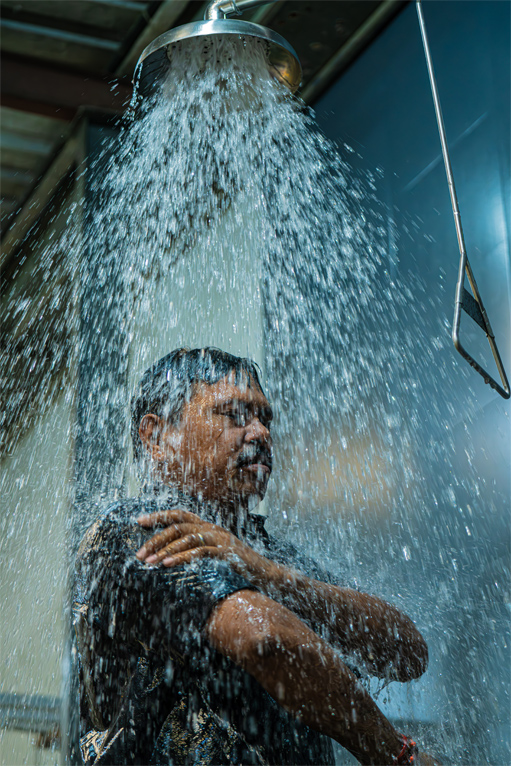 Emergency eyewash stations and safety showers must be installed at a location which can be reached quickly when needed. Safety standards emphasize that immediate access to flushing equipment is critical in reducing the severity of injuries.
ANSI Z358.1 specifies that emergency eyewash stations and safety showers should be located within 10 seconds of the hazard, with the path to the unit unobstructed and on the same level as the hazard. The equipment must be clearly identified and easily accessible so that affected individuals can begin flushing immediately.
The European standard EN 15154 similarly requires emergency equipment to be installed within 20 metres, or 10 seconds reach, of the hazard without stairs, ramps or obstacles in the path so that users can reach the unit quickly and operate it without difficulty.
Likewise, IS 10592 recommends that emergency eyewash and safety shower equipment be installed within 15m from the place of work with likely risk exposure, ensuring rapid access in case of accidental exposure.
Proper installation also requires that the units be clearly visible, properly illuminated, and maintained with an unobstructed approach, allowing workers to reach and activate the equipment without delay during an emergency.
Workplace Safety Preparedness
Emergency eyewash and safety showers are standard safety equipment in facilities where hazardous materials are present. When properly installed and maintained, these systems provide immediate flushing capability in the event of chemical exposure.
Their presence supports effective incident response and contributes to safer operating conditions in industrial environments.
 Leslico House, 2nd Floor, Prof. V. S.
Agashe Road, Dadar[W],
Mumbai – 400 028, India
Leslico House, 2nd Floor, Prof. V. S.
Agashe Road, Dadar[W],
Mumbai – 400 028, India +91- 22-24383809
 mumbai@unicaremail.com