What Safety Data Sheets Reveal About the Need for Emergency Eyewash and Safety Showers?
10 July, 2026
Safety Data Sheets (SDS) provide critical information about the hazards associated with chemicals, the potential impact of exposure, and the emergency response measures required to minimize injury.
For safety professionals, SDSs are often the starting point for determining whether an emergency eyewash, safety shower, or combination unit is required. The first-aid instructions they contain consistently reinforce the need for immediate access to flushing equipment and prolonged flushing following exposure.
When Immediate Flushing is Critical
When corrosive chemicals come into contact with the eyes, the consequences can be severe and immediate. Common chemicals include sulfuric acid, hydrochloric acid, bleach (sodium hypochlorite), and sodium hydroxide.
Safety standards require emergency eyewash equipment to be accessible within 10 seconds. Chemical burns continue causing damage until the contaminant is removed. The faster flushing begins, the lower the risk of permanent eye injury.
The same urgency applies to skin exposure. Spills involving corrosive substances, including sulfuric acid, hydrochloric acid, sodium hydroxide, and industrial cleaning chemicals, can quickly penetrate the skin and cause severe burns.
Safety showers should therefore be located within 10 seconds’ reach of the hazard. Immediate drenching helps dilute and remove hazardous substances before they penetrate deeper into the skin.
Why Continuous Flushing Matters
The instinctive reaction after chemical exposure is often to shut the eyes tightly. However, this can trap the chemical against the eye surface and increase tissue damage.
For this reason, safety standards require continuous flushing for at least 15 minutes. Prolonged flushing helps dilute and remove the contaminant, reducing the severity of injury.
The same principle applies when clothing becomes contaminated. Acids, alkalis, bleach, solvents, and pesticides can continue to cause harm while trapped against the skin. Safety showers with uninterrupted flow and hands-free operation allow the affected person to remove contaminated clothing while continuously flushing the affected area.
Certain chemicals, particularly alkalis such as sodium hydroxide (caustic soda), potassium hydroxide, and ammonia, can penetrate deeper into tissue over time. This makes immediate activation and sustained flushing critical to limiting injury to both the eyes and skin.
Emergency Equipment Must Perform Without Delay
Following exposure, the affected person may be in pain, unable to see clearly, or panicking. Emergency equipment must therefore work instantly, without requiring multiple steps or complicated operation.
Safety standards require activation from OFF to ON in less than one second, allowing flushing to begin immediately.
Effective flushing also requires a large volume of water over an extended period. Emergency eyewash and safety showers must provide adequate flow, pressure, and at least 15 minutes of continuous operation. A brief rinse is often insufficient. Sustained flushing helps remove hazardous substances and reduce the severity of injury.
What Safety Data Sheets Commonly Recommend
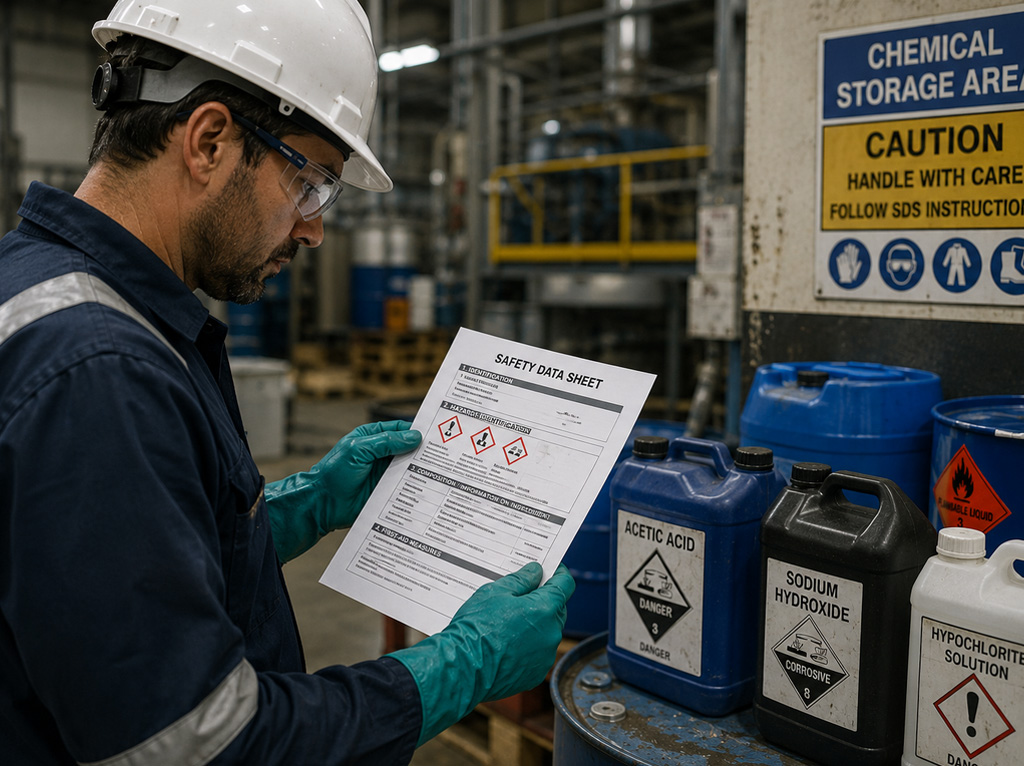
Safety Data Sheets typically recommend flushing exposed eyes or skin with water for 15–20 minutes and seeking medical attention immediately following exposure to chemicals that can cause severe eye damage and skin burns, such as bleach (sodium hypochlorite). They also reinforce the importance of having emergency eyewash and safety showers located close to potential hazards.
While personal protective equipment is an essential first line of defence, it cannot completely eliminate the risk of accidental exposure. Chemical splashes, equipment failures, maintenance activities, and human error can all result in incidents that require immediate flushing.
From SDS Guidance to Workplace Readiness
Safety Data Sheets provide practical guidance that helps safety professionals assess chemical risks and determine where emergency eyewash and safety showers should be installed to provide the fastest possible response.
At Unicare, our emergency eyewash and safety showers are designed around these same principles. From rapid activation and hands-free operation to sustained flushing and compliance with applicable safety standards, every unit is engineered to support effective emergency response and help create safer workplaces.
 Leslico House, 2nd Floor, Prof. V. S.
Agashe Road, Dadar[W],
Mumbai – 400 028, India
Leslico House, 2nd Floor, Prof. V. S.
Agashe Road, Dadar[W],
Mumbai – 400 028, India +91- 22-24383809
 mumbai@unicaremail.com